Sara Receives Electroshock Treatment in the Hospital
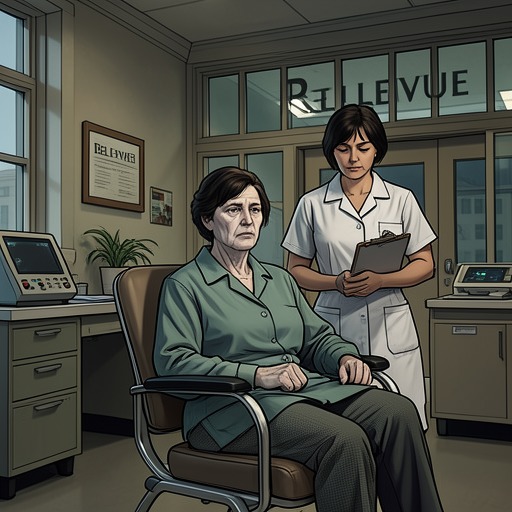
Requiem for a DreamSara Receives Electroshock Treatment in the Hospital marks the point at which Sara Goldfarb’s diet-pill crisis is treated as psychiatric illness despite a doctor’s warning that it is a medical problem. The hospital’s decision turns her confusion and physical weakness into grounds for coercion: she is sedated, unable to make herself understood, subjected to electroshock, and ultimately reduced to a mute, restrained patient whose terror is repeatedly mistaken for noncooperation.
Background and Disputed Diagnosis
Sara’s hospitalization follows a period in which her pursuit of weight loss has become bound up with the red dress she hopes to wear on television. At her first appointment, a doctor gives her a package of pills and instructions for taking them. After two weeks, she has grown accustomed to their effects, including grinding teeth and eyes that sometimes feel bulgy; she is reassured that these are normal reactions. She loses ten pounds in the first week and returns regularly for another supply. The dress’s back seems to draw closer together, while the scale’s success eclipses her misgivings.
When Sara is admitted in a completely disoriented condition, Dr. Reynolds diagnoses her as paranoid schizophrenic and recommends psychiatric care, including possible shock treatment. Dr. Spencer examines her and finds that she has been taking diet pills and Valium and has not eaten a decent meal in many months. He orders her transferred to medical, arguing that rest, proper food, and time for the stimulants and depressants to leave her body would allow her to recover. His account reframes the crisis: the symptoms that have been labeled psychiatric may instead be the consequences of drugs and prolonged poor nourishment.
The Hospital’s Decision
Dr. Spencer takes his objection to Dr. Harwood, the department administrator. He says Dr. Reynolds countermanded his transfer order and issued a standing instruction that Dr. Spencer’s orders be ignored. Spencer also points to his experience treating six patients with similar symptoms medically; all recovered in less than a month without shock treatment or psychotropic drugs. His intervention identifies an alternative course of care, but the disagreement is decided by authority rather than by a fresh consideration of Sara’s case.
Dr. Harwood defends the decision on institutional grounds. Although he knows Dr. Spencer has successfully treated similar patients, he says he did not need to examine Sara’s chart before approving the plan. He treats the likely harm of a few unnecessary shock treatments as less serious than disruption within the department, and invokes Dr. Reynolds’s seniority and authority. Dr. Spencer’s protest is therefore not simply a disagreement over diagnosis: the administrator openly places smooth departmental functioning above the individual patient’s welfare. Sara proceeds to treatment while her doctor’s warning is overruled.
Sedation, Fear, and the First Treatments
Sara goes passively to her first shock treatment, barely understanding where she is. At moments she seems close to recovering some mental clarity, but another dose of Thorazine brings back the numbness. Her limbs feel too heavy to manage; her mouth is dry and her tongue sticks to the roof of it. She struggles to form words, but cannot summon the energy to speak. In this condition, her inability to communicate becomes part of the danger: she cannot clearly tell the staff how ill and frightened she feels.
The effort to feed her becomes another ordeal. Sara cannot swallow reliably, and food dribbles from her mouth. When she tries to object, her words emerge as groans. Staff hold her down, force food into her mouth, and hold her nose and mouth shut until she swallows. The repeated pressure makes her feel as if she is suffocating; her mouth and gums are cut, and her terror intensifies. After several days, the sound of the approaching food cart makes her cringe. The care intended to feed her is experienced instead as force, while her drug-induced incapacity is treated as resistance.
Dr. Reynolds reads that incapacity as a behavioral refusal. Standing by Sara’s bed, he tells her she is not cooperating and suggests that she expects special treatment. Sara tries to raise an arm and explain that she cannot move or speak and fears she may be dying, but can produce only inarticulate sounds. Reynolds orders another shock treatment for the following morning. She is taken in a wheelchair through corridors and an elevator, intermittently conscious and hoping she might be going to see the doctor who had once spoken with her kindly. On the table, fear breaks through the drug haze, but she cannot resist as she is strapped down and prepared for the procedure.
The treatment is rendered through Sara’s overwhelmed bodily perception. Faces blur above her; something is attached to her head and something placed between her teeth. She feels electricity pass through her body as it stiffens and jerks against the table. Pain fills her head and temples, and she cannot yell, plead, or pray. The passage gives no neutral clinical distance from the procedure: its account stays with the sensation of a frightened patient who cannot understand or escape what is happening to her.
Restraint and Aftermath
Sara’s treatment is followed by further incapacitation rather than recovery. When her terror at the food cart becomes too difficult for staff to manage, they stop trying to feed her by mouth and insert a rubber hose through her nose into her stomach. They strap her into a wheelchair, tape the hose in place, and tie her hands to the chair after she reaches for it. She retches and gags; the restraints restrict her movement, and the tube makes it difficult to call for help. Unable to lift her head for long or communicate her needs, she eventually loses control of her bladder and bowels. A nurse responds with disgust and leaves her sitting in the chair. Two days later Sara remains tied there, her head hanging, as staff prepare her for another shock treatment.
After she finishes the series, Sara sits on her bed and stares through a gray window at the gray sky, ground, and bare trees. At intervals she shuffles to the nurses’ office and stands watching. When a nurse asks whether she wants something, Sara blinks and almost smiles, then returns to staring. She struggles to stretch her mouth into a grin and holds it until the nurse notices; the nurse calls it good and sends her back to bed. The gesture resembles an answer to a request for cooperation, but offers no sign that Sara has regained her former clarity or agency.
Significance
The episode links Sara’s earlier weight-loss regimen to an escalating chain of medical decisions. Pills initially presented as a manageable route to losing weight are followed by severe disorientation; a diagnosis and institutional hierarchy then determine what happens to her, despite Dr. Spencer’s account of her drug use, inadequate nourishment, and possible medical recovery. The text gives concrete weight to the difference between naming her condition and attending to her experience: Sara’s inability to speak is treated as defiance, her terror as difficulty to be controlled, and her need for help as an inconvenience.
That institutional failure is made visible not only in the disputed diagnosis but in repeated physical details: the dry, immobile tongue; food forced into her mouth; the tube taped to her head; hands tied to a chair; the gray window after the treatments. The sequence does not present electroshock as an isolated procedure detached from its surroundings. It shows a patient whose own account cannot reach those with power over her, while a doctor’s proposed alternative is dismissed in favor of hierarchy and administrative calm. By the time the treatment course ends, Sara’s remaining response is a strained smile and a return to silence.